For my first solo project I thought to myself to aim as high as possible. Obviously, my limited knowledge was the only boundary but this was not an issue. I always see the assignments as an opportunity to improve and get the best of me especially when I have all the tools I need. Despite the fact that I am a Computer Games Design, my biggest hobby regard to the industry is scripting. So, the focus of the project was to get my codding knowledge as high up as possible in a short time. In highschool I had 4 years of C++ but things are different here and little were the information I could use. I don't say I took everything right from beginning but I wasn't too prepared either.
The game I wanted to make at first was a top-down RPG I managed to get some simple animations done but was not enough and because I don't like spending too much time drawing I quit the idea for later. I reached the conclusion that the easiest way possible is to use simple geometrical shapes and rely only on gameplay and sound. The artistic part was not for me.
The production wasn't as it should have been because I didn't know how a plan should be done in order to have everything on paper before beginning. But this was not a bad thing because I could focus on scripting.
I've spent around two weeks on the development mainly because I wanted to understand and to create my own style regard to code writing.
After the game was done I was curious to get real feedback and I had my game on Kongregate. At the time I write the post I had 3 stars out of 5. I was pretty happy with this especially because "Photonic Escape" is my first ever solo made game.
This project, as well as the others, helped me to improve the way I was working as well as getting better at codding.
You can try the game here: http://www.kongregate.com/games/Paperjuice/photonic-escape
Sunday, March 15, 2015

Global Games Jam 2015
On 23rd January 2015 I participated at Global Games Jam. As the names says, is an international activity where people gather individually or in groups in order to develop a game based on a theme.
This year theme was "What do we do now?". I say activity because is not a competition as everybody is a winner after 48 ours where you went through the whole process of creating a game.
The experience on a whole is amazing because no one is obliged to participate and people who attend are really passionate and eager to make something nice and interesting. The team I took part in was composed by six people including me. After we receive the theme we started brain storming, looking for best idea possible. At some point we all agree to go with a 3d top down, gray-scale game. The story of the game is about an ex-detective that was framed after his wife was killed by someone else. Everyone thought that he is the murderer so your goal is to get the clues around the city and prove that you're not guilty.
On paper the game wasn't very hard to create as we had very good artists. I was doing the code for the game and I was pretty confident. At the end of the day, we all were here to learn as much as possible from this experience.
The first 12 hours went pretty well. We were going on straight line and and everyone had something to do. The mask managing was well done. But, as expected we started to get tired and the production slowed down a bit. Fortunately, we were on track and we had everything under control.
The only issue we had was around 12 hours before the end of the projects, Unity crashed and, even though the project was saved, the files got corrupted and we lost 6 hours of work. That was bad moment for the team because it kind managed to discourage us a bit. We got it back on tracks in couple of hours and everything was fine again.
After the 48 hours passed we were all pretty happy with our work and at the same time happy that it was all over. The experience is amazing and I think we all learned more or less from it, especially if this was the first time participating.
The game was can be played here: http://www.waterfrontgames.com/game/index/116
This year theme was "What do we do now?". I say activity because is not a competition as everybody is a winner after 48 ours where you went through the whole process of creating a game.
The experience on a whole is amazing because no one is obliged to participate and people who attend are really passionate and eager to make something nice and interesting. The team I took part in was composed by six people including me. After we receive the theme we started brain storming, looking for best idea possible. At some point we all agree to go with a 3d top down, gray-scale game. The story of the game is about an ex-detective that was framed after his wife was killed by someone else. Everyone thought that he is the murderer so your goal is to get the clues around the city and prove that you're not guilty.
On paper the game wasn't very hard to create as we had very good artists. I was doing the code for the game and I was pretty confident. At the end of the day, we all were here to learn as much as possible from this experience.
The first 12 hours went pretty well. We were going on straight line and and everyone had something to do. The mask managing was well done. But, as expected we started to get tired and the production slowed down a bit. Fortunately, we were on track and we had everything under control.
The only issue we had was around 12 hours before the end of the projects, Unity crashed and, even though the project was saved, the files got corrupted and we lost 6 hours of work. That was bad moment for the team because it kind managed to discourage us a bit. We got it back on tracks in couple of hours and everything was fine again.
After the 48 hours passed we were all pretty happy with our work and at the same time happy that it was all over. The experience is amazing and I think we all learned more or less from it, especially if this was the first time participating.
The game was can be played here: http://www.waterfrontgames.com/game/index/116
Pervasive Games
We studied many games before, each of them having different elements, rules, mechanics and so on but none of them can get any closed to the originality of this kind of games: pervasive games.
What are pervasive games? Basically, the objective of the game is to stalk and kill your target but unlike other games, this kind are real life. To get into more detail, the rules are as following: if you are the killer you are undercover. You look like a normal person with common activities as you don't want your target to suspect anything. You stalk the "prey" waiting for the right opportunity to attack while your target suspects nothing. Also, you, as a killer can be the target of someone else so pay attention to everything that surrounds you. As a killer you receive basic information of the target: a photo, a name, maybe the address, as well. Using toy weapons or harmless house tools your objective is to eliminate the target by all means. You can wait in silence outside their house, or on empty hallways, anywhere as long as there are no witnesses. After the job's done you can ask for another contract. The last player left alive or the one with most kills wins the game.
"The Seventh Victim" made in 1953, is probably the inspiration for the nowadays game, "Killer".
Also, in 1965, a movie was made after the "The Seventh Victim" called "La Decima Vittima". The shows how assassination or killing is accepted as a form of entertainment.
Over time the game received different adaptations. It reached a point where the game and real world were overlapping because you could ask people for directions or details regard to your target.
The game has this social impact as it makes people leave their home in order to actually play a game with an undetermined boundaries. In different countries this game is played in groups and they are killing eachother while the city is the playground. In UK the game is called "Street Wars".
Despite the fact that the game represents an innovation in terms of mechanics, dynamics and aesthetics, sometimes things don't go as planned because at the end of the day a game is a game and real life is real life. In Ohio, in 2006 police was alerted because of someone who was carrying a suspicious package.
The game can be played for a very long period of time as there is no restrictions.
Overall, the game idea is amazing as it makes you travel, search and take decisions in an undetermined playground.
What are pervasive games? Basically, the objective of the game is to stalk and kill your target but unlike other games, this kind are real life. To get into more detail, the rules are as following: if you are the killer you are undercover. You look like a normal person with common activities as you don't want your target to suspect anything. You stalk the "prey" waiting for the right opportunity to attack while your target suspects nothing. Also, you, as a killer can be the target of someone else so pay attention to everything that surrounds you. As a killer you receive basic information of the target: a photo, a name, maybe the address, as well. Using toy weapons or harmless house tools your objective is to eliminate the target by all means. You can wait in silence outside their house, or on empty hallways, anywhere as long as there are no witnesses. After the job's done you can ask for another contract. The last player left alive or the one with most kills wins the game.
"The Seventh Victim" made in 1953, is probably the inspiration for the nowadays game, "Killer".
Also, in 1965, a movie was made after the "The Seventh Victim" called "La Decima Vittima". The shows how assassination or killing is accepted as a form of entertainment.
Over time the game received different adaptations. It reached a point where the game and real world were overlapping because you could ask people for directions or details regard to your target.
The game has this social impact as it makes people leave their home in order to actually play a game with an undetermined boundaries. In different countries this game is played in groups and they are killing eachother while the city is the playground. In UK the game is called "Street Wars".
Despite the fact that the game represents an innovation in terms of mechanics, dynamics and aesthetics, sometimes things don't go as planned because at the end of the day a game is a game and real life is real life. In Ohio, in 2006 police was alerted because of someone who was carrying a suspicious package.
The game can be played for a very long period of time as there is no restrictions.
Overall, the game idea is amazing as it makes you travel, search and take decisions in an undetermined playground.
Games Britannia - Part Two: Monopolies and Merges
In the second part of the three-part series documentary presented by Benjamin Woolley, we saw the impact of the board games board games had in the past 200 years.
We discovered that British were the first to use a board game to develop "moral instruction" upon the players. Later, the game could be found in United States, as well. The US used them to create the idea of easy money with low efforts, known as the "American Dream".
The first major game to focus on this idea was Monopoly, where wealth and avarice are the primary keys of the game. Ironically, the game was created as a radical socialist game in Britain in 1913, now Monopoly is considered the capitalist of games.
Scrabble along with Monopoly and Cluedo survived until now despite the fact that these games were created shortly after the second World War.
Woolley also talks about how much the digital era influenced the board game industry. Games started to become more complex with new elements such as role playing like Dungeon and Dragons.
We discovered that British were the first to use a board game to develop "moral instruction" upon the players. Later, the game could be found in United States, as well. The US used them to create the idea of easy money with low efforts, known as the "American Dream".
The first major game to focus on this idea was Monopoly, where wealth and avarice are the primary keys of the game. Ironically, the game was created as a radical socialist game in Britain in 1913, now Monopoly is considered the capitalist of games.
Scrabble along with Monopoly and Cluedo survived until now despite the fact that these games were created shortly after the second World War.
Woolley also talks about how much the digital era influenced the board game industry. Games started to become more complex with new elements such as role playing like Dungeon and Dragons.
Tablut: A Case Study
The study will discuss the process in which a game with many flaws can be fixed by changing the right rules based on feedback.
The game represents the battle between two sides. One that defends and the other one that attacks. The defending pieces are situated in the middle of the boards while the pieces that attack are positioned on the edges.
The object of the game is to take the piece from the center of the board(the king) and place it on one of the edge squares.
Pieces move horizontally or vertically, one at a time. When a piece is surrounded from two sides is conquered and goes outside the board. Pieces can't jump other pieces and the center square can be occupied only by the king although pieces can pass through the king's square.
The game flaws:
I've read an article by Wayne Schmittberger in which he says that the game biggest issue is that the defending team has a big advantage over the attacker: the king can easily reach the edges of the board. In his writing he also states that several similar adaptation of the games tried to fix the problem but is very hard to get it perfectly balanced when the game is asymmetric.
Schmittberger thinks that an easy fix for the game is to apply to principles: "bidding" and "the pie" rule.
The bidding rule allows the player to bid on a number of moves before the king escapes. Whoever escapes in fewer moves gets to play the defending team, next. This rule can be implemented in many other games where one player has move advantages over the other.
The pie rule is similar to splitting a pie into half. One person cuts and the other chooses. Same for here: one player chooses the bid and the moves and the other starts moving either the attacking or the defending side.
This solutions seem to make the game fairly playable and way more balanced than before.
This rules are a general solution to this problem and can easily be applied.
The game represents the battle between two sides. One that defends and the other one that attacks. The defending pieces are situated in the middle of the boards while the pieces that attack are positioned on the edges.
The object of the game is to take the piece from the center of the board(the king) and place it on one of the edge squares.
Pieces move horizontally or vertically, one at a time. When a piece is surrounded from two sides is conquered and goes outside the board. Pieces can't jump other pieces and the center square can be occupied only by the king although pieces can pass through the king's square.
The game flaws:
I've read an article by Wayne Schmittberger in which he says that the game biggest issue is that the defending team has a big advantage over the attacker: the king can easily reach the edges of the board. In his writing he also states that several similar adaptation of the games tried to fix the problem but is very hard to get it perfectly balanced when the game is asymmetric.
Schmittberger thinks that an easy fix for the game is to apply to principles: "bidding" and "the pie" rule.
The bidding rule allows the player to bid on a number of moves before the king escapes. Whoever escapes in fewer moves gets to play the defending team, next. This rule can be implemented in many other games where one player has move advantages over the other.
The pie rule is similar to splitting a pie into half. One person cuts and the other chooses. Same for here: one player chooses the bid and the moves and the other starts moving either the attacking or the defending side.
This solutions seem to make the game fairly playable and way more balanced than before.
This rules are a general solution to this problem and can easily be applied.
Thursday, March 12, 2015
Ancient Board Games - tafl
The game of "tafl" was the only board game player by the Saxons. This is what H.J.R. Murray suggested. According to him, the game of tafl was player in Scandinavia before 400 AD.
The game is asymmetric. It is played on a square chequered board with an odd number of squares on each side. In the center of the board is placed the king while he is defended by the pieces placed symmetrical around him. The pieces that attack are twice as many.If you're playing as the defending team, the object of the game is to take the king either to the edge of the game or in the corners. I played the game but it was pretty broken as you could easily rush the king to the borders without much effort. If you're playing as the attacking team you have to surround the white king and prevent him reaching a corner square.
The pieces move only horizontally or vertically. A piece is captured if it is surrounded from two sides by the opponent. The kind must be surrounded from all four sides in order to be captured.
The game has different variations: "tablut" from Lapland, "tawl bwrdd", the Anglo Saxon "alea evangelii".
Helmfried was talking about the balance of the game as the king can easily escape to any of the square on the edge so additional rules should help.
The game is asymmetric. It is played on a square chequered board with an odd number of squares on each side. In the center of the board is placed the king while he is defended by the pieces placed symmetrical around him. The pieces that attack are twice as many.If you're playing as the defending team, the object of the game is to take the king either to the edge of the game or in the corners. I played the game but it was pretty broken as you could easily rush the king to the borders without much effort. If you're playing as the attacking team you have to surround the white king and prevent him reaching a corner square.
The pieces move only horizontally or vertically. A piece is captured if it is surrounded from two sides by the opponent. The kind must be surrounded from all four sides in order to be captured.
The game has different variations: "tablut" from Lapland, "tawl bwrdd", the Anglo Saxon "alea evangelii".
Helmfried was talking about the balance of the game as the king can easily escape to any of the square on the edge so additional rules should help.
Wednesday, November 19, 2014
Ancient Board Games - Duodecim Scripta and Tabula
Continuing the discussion about Ancient Board Games, we came across two games that are considered to be Backgammon's ancestors: Duodecim Scripta and Tabula.
 Duodecim Scripta or Ludus Duodecim Scriptorum is the game of twelve marks. Buried beneath the thick layer of lava were found, where once the citizens of Pompeii were living, two murals, 1700 years after the catastrophe that destroyed the city in eighteenth century. The first mural depicted a scene where a men accused the other of cheating. The second one was showing the inn keeper shouting at the men who better go outside if they look for a fight. Historians say that the game of Duodecima Scripta was very popular among people back then. The Roman literature has a lot of information regard to this game. Even the most important people of that time were enjoying the game as Emperor Claudius was known as an ardent player of Duodecim Scripta. He wrote a book about the game and it is said that he was always carrying the board game with him.
The game is considered to be an early version of the well-known game, Backgammon. As requirements you needed the special board game, fifteen counters each and three six-sided dice and the average game length was 30 minutes. A lot more than what a game of Backgammon might last.

The second game we spoke about last time was Tabula and historians agreed that the game is a better version of Duodeim Scripta and became played among Romans after the popularity of Ludus started to decline (10 B.C.E -54 C.E.). Around fourth century, Eastern Roman Emperor Zeno was playing a game of Tabula and fifty years later the game was described in Asia by a student. The epigram helped Louis Becq de Fourquieres to write the precise rules of the game.
Unlike Duodecim Scripta, Tabula had two rows instead of three as Backgammon has.
To conclude, despite the fact that two thousand years stay between us and the civilization that invented and played Ludus Duodecim Scriptorum and Tabula we can, in modern days, enjoy their games.
The game is considered to be an early version of the well-known game, Backgammon. As requirements you needed the special board game, fifteen counters each and three six-sided dice and the average game length was 30 minutes. A lot more than what a game of Backgammon might last.

The second game we spoke about last time was Tabula and historians agreed that the game is a better version of Duodeim Scripta and became played among Romans after the popularity of Ludus started to decline (10 B.C.E -54 C.E.). Around fourth century, Eastern Roman Emperor Zeno was playing a game of Tabula and fifty years later the game was described in Asia by a student. The epigram helped Louis Becq de Fourquieres to write the precise rules of the game.
Unlike Duodecim Scripta, Tabula had two rows instead of three as Backgammon has.
To conclude, despite the fact that two thousand years stay between us and the civilization that invented and played Ludus Duodecim Scriptorum and Tabula we can, in modern days, enjoy their games.
Wednesday, November 12, 2014
Senet and The Royal Game of Ur
Last lecture (07.11.2014) we spoke
more about the ancient games. The purpose of the lectures is for us to get a
better understanding of the history by playing some of the oldest games ever
found. Even though archaeological evidence suggests that the earliest board
games are four thousand years old, we got the opportunity to try out two, more
recent games: Senet (the game of 30
squares) and The Royal Game of Ur
(aka the game of 20 squares ).
Before I start writing about the gameplay experience of these two, I
will add some board game classification.
H. J. R. Murray, historian, classified board games in five groups:
-Game of alignment and configuration (eg Noughts and Crosses, Nine Men’s
Morrie etc.)
-War games (eg chess)
-Hunt games (eg fox and geese)
-Race games (eg backgammon, pachisi etc.)
-Mancala games (eg mancala)
In 1960 Bell, R. C. organised games into six categories:
-Race games (eg pachisi)
-War games (eg chess)
-Games of position (eg noughts and crosses)
-Dice games(eg hazard)
-Domino games(eg ma-jong)
 The Royal Game of Ur or the
game of 20 squares date from around 2600BC. We played the game and the rules
encourage players use strategy in order to win. The interaction between players
is high which makes the game very competitive.
The Royal Game of Ur or the
game of 20 squares date from around 2600BC. We played the game and the rules
encourage players use strategy in order to win. The interaction between players
is high which makes the game very competitive.

Senet or the game of 30 squares is considered to be five
thousand years old. Has some similarities with the Royal Game of Ur in terms of player interaction but the rules
and the layout of the game are different.
All in all, both board games are very valuable historical artifacts. The
Royal Game of Ur and Senet can be considered parents of games
that were discovered afterwards. The strategy and player interaction found in
these two can be seen in various modern games.
Wednesday, November 5, 2014
Games Britannia - Part One: “Dicing with Destiny”
Benjamin Woolley, a biographer and historian, starts a series of documentaries talking about the evolution of games in Britain, starting with the Iron Age and going through history until the Information Age, discovering and analysing how games influenced the society.
The documentary starts with Benjamin Woolly saying how diverse were the reasons why people were playing games: for fun, for friendship, for intellectual purposes,for education and often for money. Even the locations were very different one from another: from churches to pubs and casinos. There was no doubt that people were feeling the need of playing games no matter the purpose or the place.
In 1996 an archaeological team found a well preserved board game near Colchester that is believed to be two thousand years old and belonged to the Romans. The game was called Stanway Game. It had no dice of any kind in the box the game was found so it has to be a strategy game.
Even though we often say that is just a game, for the ancient society games were more than that. They were battle of chance and destiny and most of the time historical events can be depicted from this board games. Nowadays teenagers play video games to escape reality and to live different events that in real life were most of the time impossible.
Later in the documentary, Benjamin Woolley finds a game in an early version of the Bible that can be consider the map of a religion. Might symbolise the fight between good and evil, a path a man should take to get to Heaven.
Games have different interpretation based on the mechanics they use. On one hand there were games that focus on luck as people's lives are most of the time influenced by destiny and on the other hand were games that focus on skill. Woolley says that life is a combination between these two.The perfect games should contain both of them. A game of such complexity might be backgammon.
Game historian, Caroline Goodfellow says that game are a good way of having fun and waste time mostly because humans, unlike animals, tend to get bored.
Nine men's Morris is a very common game similar to "X's and O's" that can easily be found anywhere. In cathedrals you can find carved drawings of the game in stone.
Later in history, dice were considered a tool of evil as no faith is worth being decided only by luck. Also, many considered that you can cheat with ease using dice.Hazard is a game where you bet money on the outcome of the rolled dice. Another game of pure chance is Faro. The difference is it uses decks of cards instead of dice. Usually the game is played in casinos for money. Because the prizes consist most of the time in money the stake was really high and addicted gambling players can become a real problem to society due to the fact that losing could cost them, literally, a fortune.
The church started to see dice as a real menace to community's life, so people found an alternative: a spinner with number written on the margins. Very similar to dice but with different shape.
Snakes and ladders is another well known game that is actually inspired by an Indian game named Gyan Chapoor. The game doesn't rely on competition. It focuses on the spiritual path the human must take to reach the balance and happiness.
Chess it is considered to be on of the most evolved game in terms of strategy that is easy to learn but very hard to master. The game is dated around 18th century in India. It was so well designed that lasted for two hundred years~ without any changes gameplay changes.
This concludes the first part of the documentary Games Britannia: Dicing with Destiny.
Thursday, October 23, 2014
Battleships Iteration
Classic games are pretty straight-forward. Easy to learn, with simple rules and not many strategies to master, or probably not strategy at all. Just a bit of luck, pens, paper and you are ready to go. This kind of games don't vanish in time because are easy to learn and carry around, being a good source of fun on-the-go.
On Friday class, held on 17th October we had to split in pairs and play a game of battleships. As expected, everybody was already familiar with the game and everything went smoothly. At the end of the "playing phase" people were saying that they felt all kind of emotions: from the frustration of not hitting the opponent ship to the joy of guessing turn after the turn where the opposite player's ship is.
As a task, we were told to add some new elements or rules to the game in order to change the gameplay and perhaps the feelings players get. I came up with the idea of adding three bombs on each player's map. If the opponent guesses the position of the bomb on the board he destroys everything around the triggered bomb. People came up with a lot of new interesting ideas such as stacking ships, collecting materials in order to repair any damages, random-shaped ships and so on.
It was a nice exercise to see how the experience changes if we add or subtract elements from a game.
On Friday class, held on 17th October we had to split in pairs and play a game of battleships. As expected, everybody was already familiar with the game and everything went smoothly. At the end of the "playing phase" people were saying that they felt all kind of emotions: from the frustration of not hitting the opponent ship to the joy of guessing turn after the turn where the opposite player's ship is.
As a task, we were told to add some new elements or rules to the game in order to change the gameplay and perhaps the feelings players get. I came up with the idea of adding three bombs on each player's map. If the opponent guesses the position of the bomb on the board he destroys everything around the triggered bomb. People came up with a lot of new interesting ideas such as stacking ships, collecting materials in order to repair any damages, random-shaped ships and so on.
It was a nice exercise to see how the experience changes if we add or subtract elements from a game.
Wednesday, October 22, 2014
Games classification.
Based on a French sociologist (Roger Cailloins) notions, games were slit into two groups: Paidia and Ludus.
Paidia refers to "play" for pleasure, games usually have no hard rules to follow. A good examples are SimCity series, Minecraft, GrandTheftAuto series and so on. Player could just take a break from the quest/ missions-side part of the game and enjoy free roaming.
On the other hand, games classified as Ludus are constrained by rules and usually the player focuses on winning.
After the game is classified as either Ludus or Paidia, based on the gameplay, ther are: Agon that refers to competition, Alea which is the element of randomness or chance in a game, Ilinx refers to movement and Mimicry which is defined as simulation or role-play.
I chose to classify Heroes of Newerth and Diablo III
Heroes of Newerth is a game that can easily be classified as Ludus. There is no free roaming and the games is definitely constrained by a set of rules. Two teams of five battle each other in order to destroy the opponent's base. Every player choose one hero to play with and they are ready to go. Every match lasts in average around 40-50 minutes and progression is not saved after the battle concludes. In terms of gameplay HeroesOfNewerth has elements of Agon because of the high competitive community. I might also say that the game asks for a certain amount of luck/chance because, unless you party up with some friends, you'll get random teammates who might not be as good at the game as you so are therefor the game has Alea elements. I don't think Mimicry can be found here because you're not playing an RPG so there is no role-play.
Unlike HeroesOfNewerth, Diablo III doesn't focus on competition/Agon even though the game can be classified as Ludus because of the leaderboards and the community you're competing with indirectly. Diablo III also lets players the opportunity to explore the world of Sanctuary without being force to follow any rules (except the fact that you have a well-defined game area). Here we can easily see the element of role-play or Mimicry. The game main focus is on Alea or chance because Diablo III uses the RNG (random number generator). The map will always be randomly generated as well as the drop amount and quality of items.
Unlike HeroesOfNewerth, Diablo III doesn't focus on competition/Agon even though the game can be classified as Ludus because of the leaderboards and the community you're competing with indirectly. Diablo III also lets players the opportunity to explore the world of Sanctuary without being force to follow any rules (except the fact that you have a well-defined game area). Here we can easily see the element of role-play or Mimicry. The game main focus is on Alea or chance because Diablo III uses the RNG (random number generator). The map will always be randomly generated as well as the drop amount and quality of items.
Wednesday, October 15, 2014
Bibliography -updated-
1. Author:
Chandler, H. and Chandler, R.(2009) "Fundamentals of Game Development". London. Foundations of Game Development.
Chandler, H. and Chandler, R.(2009) "Fundamentals of Game Development". London. Foundations of Game Development.
2. Reader:
Malone, T. and Lepper, M.(1987) "Making Learning Fun: A Taxonomy of Intrinsic Motivations of Learning" in Snow, R. E. and Farr, M. J Aptitude, Learning, and Instruction: Volume 3: Cognitive and Affective Process Analyses. v. 3. Hilsdale. NJ: Erlbaum. pp. 223-253.
3. Journal:
Adachi, P.J. and Willoughby, T. (2013) "More than just fun and games: The longitudinal relationships between strategic video games, self-reported problem solving skills, and academic grades, Journal of Youth and Adolescence", 42, 1041-1051. doi:10.1007/s10964-013-9913-9
Malone, T. and Lepper, M.(1987) "Making Learning Fun: A Taxonomy of Intrinsic Motivations of Learning" in Snow, R. E. and Farr, M. J Aptitude, Learning, and Instruction: Volume 3: Cognitive and Affective Process Analyses. v. 3. Hilsdale. NJ: Erlbaum. pp. 223-253.
3. Journal:
Adachi, P.J. and Willoughby, T. (2013) "More than just fun and games: The longitudinal relationships between strategic video games, self-reported problem solving skills, and academic grades, Journal of Youth and Adolescence", 42, 1041-1051. doi:10.1007/s10964-013-9913-9
Saturday, October 4, 2014
Like forgetting the door open...
. ...And suddenly guests come in and I feel
like I have to introduce myself. I might not be the best host out there but for
sure I'll do my best, so whoever comes in can read a little about me. I have
some answers at some question people might ask so they can get a glimpse of idea
about who I am.
 In the past two months I stopped reading fiction literature because
I had to focus on the university application as well as getting some
information about what I was about to do when the courses start. Beside programming
languages and some articles about how to model in different computer graphics
software, nothing else was to be read. Before that period of time, probably
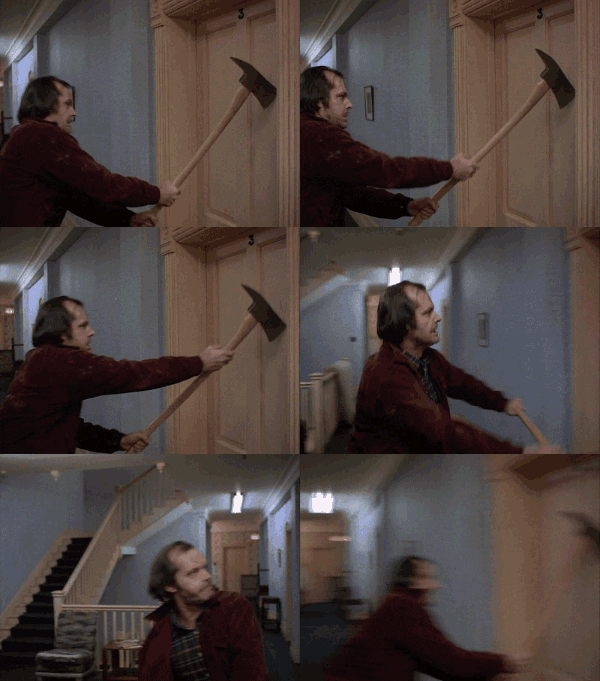
four months ago I finished reading “The Shinning” by Stephen King. I really enjoyed
his book because his writing techniques appeal to my taste as he can make me
feel anxious and most of the time uncomfortable. King tell his stories in such
way you can feel a shiver down your spine when you read them. He is a master when it comes to horror novels.
In the past two months I stopped reading fiction literature because
I had to focus on the university application as well as getting some
information about what I was about to do when the courses start. Beside programming
languages and some articles about how to model in different computer graphics
software, nothing else was to be read. Before that period of time, probably
four months ago I finished reading “The Shinning” by Stephen King. I really enjoyed
his book because his writing techniques appeal to my taste as he can make me
feel anxious and most of the time uncomfortable. King tell his stories in such
way you can feel a shiver down your spine when you read them. He is a master when it comes to horror novels.
 I had to read a lot of non-fiction books this year, especially in
May because the final exams were right around the corner and I had to prepare a
total of seventeen Romanian writers. Even though I was supposed to write about
one author, I could not rely on luck so the best thing to do was to read one
book for every writer on the list. I can honestly say that I enjoyed each and
every book I chose. Different styles, different stories, each book had
something new and interesting to show to the reader. Although was a pleasure to
read them all, I can’t deny the fact that the one that I liked the most was “Morometii”
by Marin Preda. The story is set between First and Second World War. The book focuses
on Moromete family that struggles to
stay unite in uncertain and unpredictable times, caught between two major
historical disputes. I recommend the book to everyone that likes drama, history
and humor.
I had to read a lot of non-fiction books this year, especially in
May because the final exams were right around the corner and I had to prepare a
total of seventeen Romanian writers. Even though I was supposed to write about
one author, I could not rely on luck so the best thing to do was to read one
book for every writer on the list. I can honestly say that I enjoyed each and
every book I chose. Different styles, different stories, each book had
something new and interesting to show to the reader. Although was a pleasure to
read them all, I can’t deny the fact that the one that I liked the most was “Morometii”
by Marin Preda. The story is set between First and Second World War. The book focuses
on Moromete family that struggles to
stay unite in uncertain and unpredictable times, caught between two major
historical disputes. I recommend the book to everyone that likes drama, history
and humor.
What is the last live performance (music, drama or dance) you attended?
 My last live performance I attended was in Bucharest, a couple months
ago when I went to see a Romanian rock band playing live. They did an awesome
job on stage. I was very pleased I could go and see them. One of the best
experience I had.
My last live performance I attended was in Bucharest, a couple months
ago when I went to see a Romanian rock band playing live. They did an awesome
job on stage. I was very pleased I could go and see them. One of the best
experience I had.
What is the title of the last film you saw at the cinema/online or watched on DVD.
The last movie I watched on DVD was “The Number 23”
which is a psychological thriller film written by Fernley Phillips, starring Jim Carrey. The film is really
intense, has a captivating story and an unexpected ending. Go watch it if you have't already!
 I don’t read newspaper as most of the news I get to
know about are from television, social media or friends. I believe newspapers
are not a good way of staying updated to social life nowadays mostly because there
are better and faster ways of getting information.
I don’t read newspaper as most of the news I get to
know about are from television, social media or friends. I believe newspapers
are not a good way of staying updated to social life nowadays mostly because there
are better and faster ways of getting information.
 I remember
that, before the school ended, I visited an art gallery in Bucharest that had
exposed all kind of contemporary paintings that, to be honest, were very hard
to comprehend. Most of them were very minimalistic and had almost no “art
elements”. Probably that’s why I focus on programming and not on designing. All
in all, it was a nice and quite unique experience.
I remember
that, before the school ended, I visited an art gallery in Bucharest that had
exposed all kind of contemporary paintings that, to be honest, were very hard
to comprehend. Most of them were very minimalistic and had almost no “art
elements”. Probably that’s why I focus on programming and not on designing. All
in all, it was a nice and quite unique experience.
 Now that I am away from home and I have to take care of everything, I would
say I probably spend about ten hours a week playing video games but before coming to university I had a lot
more. Playing games on computer was the most common way of entertainment. After
a long day at school ( most of the time I had about six/seven courses a day),
video games were the best way of relaxing. I believe this was for the best
because I’ve learned a lot from playing video games, to be honest, such as
history, geography, time and money management, I developed good reflexes and
good skills in communication. Definitely it was not a wasted time.
Now that I am away from home and I have to take care of everything, I would
say I probably spend about ten hours a week playing video games but before coming to university I had a lot
more. Playing games on computer was the most common way of entertainment. After
a long day at school ( most of the time I had about six/seven courses a day),
video games were the best way of relaxing. I believe this was for the best
because I’ve learned a lot from playing video games, to be honest, such as
history, geography, time and money management, I developed good reflexes and
good skills in communication. Definitely it was not a wasted time.
How many hours a week do you spend playing games other than video games?
 To be honest, the only games I played
other than video games were chess and backgammon. My father is very good at
chess and he usually had time for one or two skirmishes. Other than that, I
didn’t play board games of any kind except “Catan”, “Monopoly” and some card
games from time to time, so on average I probably spend less than an hour a
week .
To be honest, the only games I played
other than video games were chess and backgammon. My father is very good at
chess and he usually had time for one or two skirmishes. Other than that, I
didn’t play board games of any kind except “Catan”, “Monopoly” and some card
games from time to time, so on average I probably spend less than an hour a
week .
What is the title of the book (fiction) you are currently reading, or
what is the title of the last fiction book you read?
 In the past two months I stopped reading fiction literature because
I had to focus on the university application as well as getting some
information about what I was about to do when the courses start. Beside programming
languages and some articles about how to model in different computer graphics
software, nothing else was to be read. Before that period of time, probably
four months ago I finished reading “The Shinning” by Stephen King. I really enjoyed
his book because his writing techniques appeal to my taste as he can make me
feel anxious and most of the time uncomfortable. King tell his stories in such
way you can feel a shiver down your spine when you read them. He is a master when it comes to horror novels.
In the past two months I stopped reading fiction literature because
I had to focus on the university application as well as getting some
information about what I was about to do when the courses start. Beside programming
languages and some articles about how to model in different computer graphics
software, nothing else was to be read. Before that period of time, probably
four months ago I finished reading “The Shinning” by Stephen King. I really enjoyed
his book because his writing techniques appeal to my taste as he can make me
feel anxious and most of the time uncomfortable. King tell his stories in such
way you can feel a shiver down your spine when you read them. He is a master when it comes to horror novels.
What is the
title/topic of the book (non-fiction) you are currently reading, or what is the
title /topic of the last non-fiction book you read.
What is the last live performance (music, drama or dance) you attended?

What is the title of the last film you saw at the cinema/online or watched on DVD.
 |
How
often do you read a newspaper? (Which one? Online or physical?)

Which
art gallery/museum/ exhibition did you last visit?

How
many hours a week do you spend playing video games?

How many hours a week do you spend playing games other than video games?
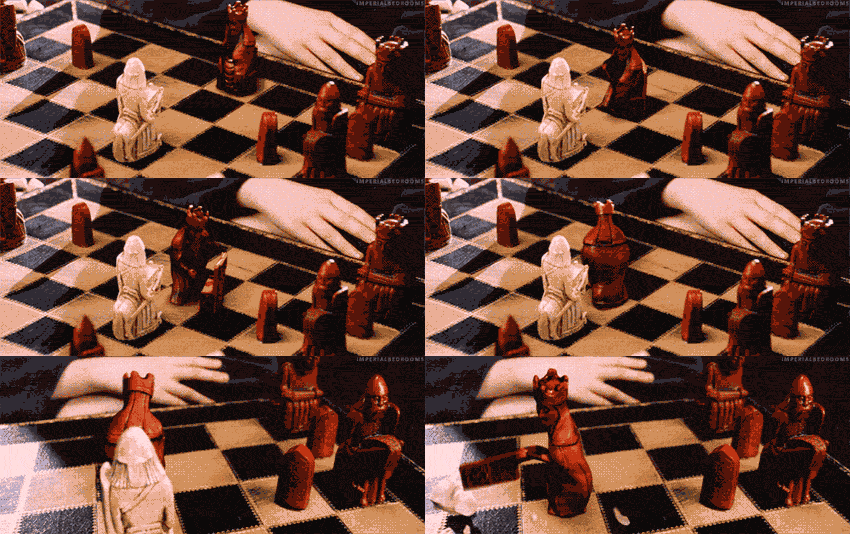 To be honest, the only games I played
other than video games were chess and backgammon. My father is very good at
chess and he usually had time for one or two skirmishes. Other than that, I
didn’t play board games of any kind except “Catan”, “Monopoly” and some card
games from time to time, so on average I probably spend less than an hour a
week .
To be honest, the only games I played
other than video games were chess and backgammon. My father is very good at
chess and he usually had time for one or two skirmishes. Other than that, I
didn’t play board games of any kind except “Catan”, “Monopoly” and some card
games from time to time, so on average I probably spend less than an hour a
week .
Subscribe to:
Posts (Atom)